Author Brené Brown has some really good things to say about what church should be and, at its best is, about: being with people through pain and loss:
Her point is that the church exists to help people through their lives, not to give people an escape from their lives. Jesus' birth, life, death, and resurrection--what we call his incarnation--is all about triumphing over the world by moving through the world. Worth thinking about.
Showing posts with label church. Show all posts
Showing posts with label church. Show all posts
Friday, August 9, 2013


Thursday, December 20, 2012
The Church: Hospital, School, Fitness Club, or Inn?
In a recent dedication of a new building at St. Martin's Episcopal Church in Houston, Texas (the largest Episcopal church in the United States), former Archbishop of Canterbury George Carey said:
This is a frequent lament by pastors and priests: we have larger numbers of people in our pews on Christmas, Easter, and after traumatic national events but those people don't seem to be interested in sticking around and becoming a part of the faith community. Those of us who are part of this faith community are often puzzled about this. However, reflecting on what church means for people, such a phenominon, while perplexing to those who have made the church their spiritual home, makes sense based upon a person's view of what church is. Four views come to my mind.
Abigail Van Buren (Dear Abby) has been famously quoted as saying that "a church is a hospital for sinners, not a museum for saints." Over and over again, I've heard this sentiment expressed--especially in evangelical circles. Pastors see the ravages of sin and death all around us and say "come to the church to be cured!" This model of the church certainly has its good points. Ever since Jesus' time, Christians have been heavily involved with healing. The founding of many hospitals has been at the behest of churches. Some people naturally gravitate towards churches when they are in need of healing. That's why we have a healing service as part of our worship every third Sunday (next one is January 20). The difficulty with this view of the church is twofold. First, there are plenty of people in the world who don't see themselves as having a "sin sick soul", to quote a famous hymn. If you don't feel like you are sick, why visit a doctor or a hospital? No one visits a hospital unless one is sick, visiting someone
who is sick, or occasionally getting some preventative care to keep from
becoming sick. Second, even if one does visit a hospital, no one stays there longer than absolutely necessary. So when people show up at our churches with acute needs and find some comfort and healing there, we shouldn't be surprised that they don't stay. After all, now that they're feeling better, why keep visiting the hospital/church?
There is also the popular notion of the church as school. Again, churches have been some of the primary founders and supporters of schools--we've seen it as part of our vocation to care for children and to help them be formed and educated. In the church, we used to think of this only in terms of imparting information: telling Bible stories, recounting church history, teaching about the sacraments, etc... We've evolved into realizing that being a follower of Christ requires not just education, but formation. Recently, the National Association for Episcopal Christian Education Directors (NAECED) changed its name to Forma, reflecting not only an easier name to remember but also a shift from the notion of education (imparting information) to formation (shaping the whole person). Even so, the difficulty with this idea of the church as a school is also twofold. First, there are people who are not looking to be educated. Just as they don't feel sick enough to go to a church-as-hospital, they don't feel uneducated enough to to a church-as-school. In fact, they may even have been hurt by the church or a church-related school in some way and a loathe to repeat the experience. Second, one traditionally graduates from school, but ideally no one "graduates" from church! We've seen some of this notion play out with the rite of Confirmation (adult affirmation of faith). Many times, it has been seen as a graduation from church for teenagers--their parents made them go to church when they were children, but now that they've been confirmed they don't need to go anymore. When we talk about this area of our life together as lifelong Christian formation rather than matriculation through a set of requirements it makes it clear that we're not just imparting information.
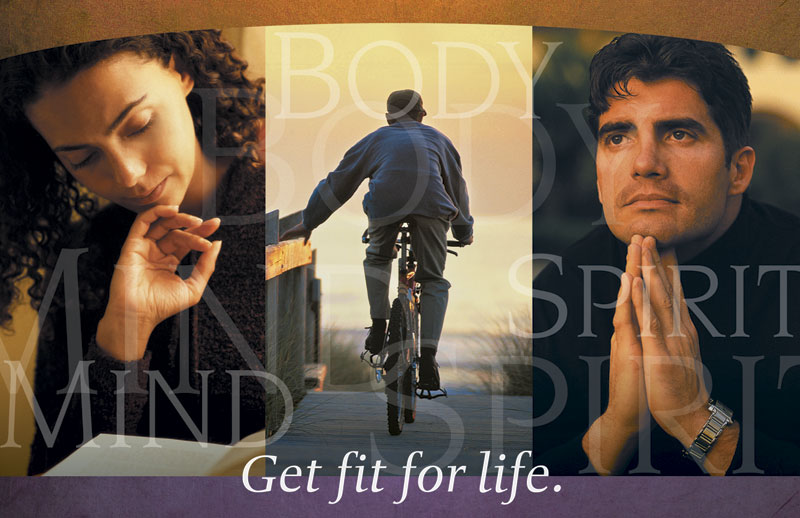 With the evolution of being equipped to follow Christ moving from education to formation, many people man now look upon church as a fitness club--getting in shape for Jesus. The difficulty with this idea is obvious--how many people are truly excited about getting regular exercise? Even more telling, how many are excited about getting regular spiritual exercise? Frankly, this is what trips most people up--we all can become spiritually lazy (and pastors are not exempt). We can often exist on a sort of spiritual inertia until some crisis intrudes for which we are spiritually ill-equipped, then it is a trip to the church-as-hospital. Also, like physical exercise, we don't really think of ourselves as having the time to spiritually exercise--we're too busy doing other things. So when we talk about getting "fit for life" or other fitness metaphor, people have to overcome inertia, busyness, and lack of motivation to show up on Sunday mornings--and we don't often make explicit what we're doing. What would you do if you simply showed up to your local fitness club and there were people working out on strange machines, and talking with each other (some in great shape, some "in progress") and no one gave you any sort of orientation? Or what if you showed up to a fitness club and the room was empty of equipment? You would likely head back out the door. That is what I suspect church often looks like to the unchurched--a lot of strange looking hardware (what is a chalice? a paten? candles? prayer books? hymnals? organ music?) and odd routines without any sort of guidance about how to use them or what they are for. We need to be more explicit about how we are forming and spiritually exercising people.
 Finally, appropriate for the season, some people see the church as an inn, or hotel. On the bad side of this, the church can degenerate into being seen as a social club--an exclusive place where the "beautiful people" congregate to reinforce how nice things are. That was the genesis of the Dear Abby quote about the church not being a "museum for saints." We don't want to be seen as, or actually be, a place where one must be perfect to attend. I've seen people apologize for crying in church! Why apologize? Because it is seen as not "seemly." Well, church should be the one place in which we can express our deepest emotions, so cry away! People also can see the church as a place for rich people--much like going to a hotel with a fancy lobby. The question "Do I fit in here?" is often at the top of people's minds when the visit a church. I actually think that an inn is a wonderful metaphor for the church. We need to constantly look at how hospitable we are: Are we easily seen from the road? Is our signage good and clear? Can people find their way to our front door easily? Are they welcomed warmly when they do? Does the place feel like an exclusive club or a warmly welcoming bed and breakfast? We might even be seen as having a (spiritual) exercise room, a buffet (coffee hour?), a spa for healing (holy oil at the healing service?), even a classroom or two.
 I'm going to continue to reflect on the inn metaphor for church in the coming weeks. I think it is a rich one. We often talk about the church as "my church" as if we somehow own it. This does make us feel more at home (after all, how much more at home can you feel then when you are at home?) but may make others feel like they are temporary and unexpected guests rather than potential members of God's family. I much prefer the image of the church building that I learned as a child: God's house. We are all in God's house. We are all staff (paid or unpaid) and we are welcoming guests who intentionally seek us out as a place to rest that is apart from the hustle and bustle of the world. We also need to be mindful that God is both our host and our permanent guest--we need to make sure we have room in each of our "inns" for God as the Christ child. We also need to be aware of whether we're "living the Gospel in a relevant way" as a church--making sure that we are adapting well to changing needs and providing things for which people seek out the church. I'm not suggesting that we become some sort of plastic "dream church" for everyone, but that we make sure that we are engaged in actively living the gospel in the world rather than merely supporting one another.
As we end Advent and approach the Christmas season, may we have room in our hearts for Christ, our homes for one another, and our church for those who seek a place of rest and refreshment--and perhaps an appointment with the One who is Emmanuel, God with us.
“Those [churches] that are growing are living the gospel in a relevant way with energetic leaders who adapt, good lay leadership and dynamic preaching...”Reading that this morning caused some thoughts to coalesce that have been drifting around for a while. As a response to the Newtown, Connecticut shootings, commentator (and ordained minister) Mike Huckabee famously talked about the tragedy as not surprising considering that "we've systematically removed God from our schools." He goes on to lament the fact that Americans often pretty much ignore God until a crisis hits, then go running to church in search of comfort only to vanish weeks or months later after the ripples from the latest tragedy have died down. The fallacy in his argument, beyond its pastoral shortcomings, lies in equating the church with God. But that theological discourse will have to wait for another post.
This is a frequent lament by pastors and priests: we have larger numbers of people in our pews on Christmas, Easter, and after traumatic national events but those people don't seem to be interested in sticking around and becoming a part of the faith community. Those of us who are part of this faith community are often puzzled about this. However, reflecting on what church means for people, such a phenominon, while perplexing to those who have made the church their spiritual home, makes sense based upon a person's view of what church is. Four views come to my mind.
 |
| St. Luke's Hospital, San Francisco |
 |
| Photo from the Forma web site--Godly play. |
As we end Advent and approach the Christmas season, may we have room in our hearts for Christ, our homes for one another, and our church for those who seek a place of rest and refreshment--and perhaps an appointment with the One who is Emmanuel, God with us.
Tuesday, September 13, 2011
Pressing on Towards the Goal
I press on to take hold of that for which Christ Jesus took hold of me. Brothers and sisters, I do not consider myself yet to have taken hold of it. But one thing I do: Forgetting what is behind and straining toward what is ahead, I press on toward the goal to win the prize for which God has called me heavenward in Christ Jesus. - Philippians 12b-14This past Sunday morning, coincidentally on the tenth anniversary of September 11, 2001, I announced that we had reached the point in our life together where we needed to be about the work of (re-)planting St. Edward's and announced that we were formally beginning that replanting effort. Replanting a church means re-launching the church in a fresh new way that honors the past yet looks towards the future. In other words, while we do have already existing buildings, budgets, and committed members, we need to look to the world and essentially say "We're planting a new church. How should we go about doing that, assuming we were just starting out with nothing?"
There are two challenges we face as we re-plant St. Edward's. The first challenge is that our mission context is vastly different from the one that existed 55 years ago at our first "planting." The culture of sometimes explicit, often tacit, social supports to our faith--often called "Christendom"--is dead and is not returning. The world outside our doors is almost completely secular and often, at best, looks upon the church as a curious anachronism of a bygone era. It is thus a huge challenge to convince any twenty-first century American that church has anything to say that would be applicable, much less transformational, to his or her life.
That is not to say that people are not spiritually hungry and thirsty--they very much are. Sometimes, especially around significant life events, the pull of ritual and church ceremony exerts itself. This past weekend we had over 200 people at St. Edwards. Those people were spread over four services (two funerals, our 9 a.m. Eucharist, and the 9/11 commemorative service) but I would like to think that we made at least a minimal impact for Christ on the life of each person who came through our doors. Note that since neither of the funerals were for current members, fully three-fourths of the people who sat in our pews at some point during the weekend were not our members. This doesn't even count the many Christian brothers and sisters who were here as part of the Ethiopian Orthodox Church that meets in our church building on Saturday mornings! It also doesn't include the many twelve-step or other groups that use our social hall and Fireside Room. Clearly our buildings have been and continue to be well used by God, if not necessarily by us.
The key, of course, is (to use Diana Butler Bass' terminology) to help the spiritual "tourists" who are here for a single experience to join us as spiritual "pilgrims" on a long journey of faith. To even hope to do so, we have to admit to the second challenge: we often succumb to "tourist Christianity" (my term) ourselves. We sometimes think of our financial contributions to the church as a mere payment for services rendered, we ask "what am I getting out of being here" and, if the answer seems to be "nothing," we are tempted to move on. Sometimes we even find a good spot along our own pilgrimage trail and set up housekeeping, not very much interested in moving forward to new things. No one is immune from these temptations, even clergy! A more pointed version of this indictment was recently expressed by The Rev. Frederick W. Schmidt, an Episcopal priest and avid blogger, who wrote:
What Muslims have rightly criticized in western culture is that it is spiritually flaccid and self-indulgent. The churches of Europe are empty. While they are not as empty in the United States as they are in Europe, Christians here often live remarkably dissolute and directionless lives that are not easily distinguished from the lives of those around them. We are without discipline. We live as if our faith in God doesn't matter. And in our desire to not be thought of as fundamentalists we have crafted churches that are a studied attempt to avoid deep commitment.In today's post-Christendom, post-9/11, and increasingly post-Christian society, any attempt to plant (or re-plant) a church that is "a studied attempt to avoid deep commitment" is doomed to failure. People do not seek out hospices unless they or a loved one are dying. People do not seek out churches designed to be (or that have come to be) spiritual hospices unless they simply want to be comfortable as they decline. Offering Karl Marx's "opiate to the masses" is no longer an effective long-term growth strategy, if it ever was.
If you are a member of St. Edward's, please don't read this as some sort of blanket condemnation of your commitment to St. Edward's, much less your commitment to Jesus Christ. A great many of you have served long, faithfully, and well in a variety of capacities over the many years St. Edward's has been here--some of you from the very beginning of its existence! You have left a lasting legacy for future generations and continue to come and support the church as best you are able. As wonderful as that is, however, I am asking everyone to actively support, commit to, or at the very least not oppose the inevitable changes that every new effort like (re-)planting a church brings. Stay with us, ask for help on the pilgrimage if you need it, and pray and expect God to do wonderful things in your life and in the life of those who have yet to walk through our doors.
So, to borrow from St. Paul, we are forgetting what lies behind--the difficulties of the last decade at St. Ed's, the pain and loss involved in the split in March 2009, some of the initial missteps of the last couple of years, and the lingering fear and uncertainty that follow such things--and we are straining toward what is ahead and pressing on toward the goal of responding faithfully to our own call from God to welcome all, worship fully, witness to God's grace, and walk the way of Christ. I invite you to pack up your spiritual backpack and join me on the adventure.
Wednesday, June 15, 2011
Getting Out and Getting Real
"I won't argue that I have all of the answers. I won't claim to have named all of the challenges that you are facing. For all that we hold in common, each of us have an experience that is all our own. But I will offer you a place to begin doing your own spiritual work, a place to talk about what is happening "out there" in the spiritual landscape that we all journey, a conversation partner, a place to begin thinking spiritually about the life you live, and thoughts to build on or to reject. Come what may -- and your responses will have a lot to do with what we discuss -- my hope is that you will be a little clearer about what you believe, why you believe it, why it matters, and how it shapes your life."I had a great experience today--I went and had lunch with our Priest Associate for Evangelism, Julie Nelson, at her office. In many ways it was a 19 year flashback to my "before seminary" days as a Technical Support Specialist at a computer hardware and software company. I left the secular workforce in July 1992, entered seminary, graduated and was ordained in 1995 and have spent over 15 years in one parish ministry or another. It was almost surreal being back in that environment--and I was only in the cafeteria!
-- "The Dave Test," The Reverend Dr. Frederick W. Schmidt, Jr.
Julie can probably speak to this more than I can, but after our great lunch talking about future possibilities at St. Edward's I drove back to the church thinking: "How many of the hundreds of people on that campus have any relationship with any church of any kind and how many of them will be impacted (or fail to be so) by the Episcopal Church?" It seemed like "the church world" (where I spend 98% of my working life) and the "real world" are, literally, worlds apart. I eat, drink, and live church--it's my passion, perhaps occasionally my obsession. On my best days, that passion goes hand-in-hand with my love of God in Christ and my conviction that God is at work in the world and in and through each one of us. On my less-than-best days, it is simply a passion for sustaining the institution and something that can push more important things to the side if I'm not careful.
Being out there "in the world" forces me to confront a critical question: What does the church have to say to, for example, a 30-something software engineer with a wife and children, who works long hours, has precious little family time, and the usual raft of personal challenges common to everyone? Is he going to get up on Sunday morning and show up at 9 a.m., family in tow, to experience worship at St. Edward's? Probably not, unless he has either heard of us (positively!) from someone, someone invites him to church, or he attends some other event where he is introduced to what we offer folks here. I don't have to go 25 minutes north to Julie's office to think about this, either. About 1,000 feet away from where I'm typing in my office is Xilinx, a microchip company literally just over the overpass. I'm guessing that some of the same types of people who work where Julie does work at Xilinx as well.
My thoughts about connecting "the church world" with "the real world" coalesced when I ran across the article: The Dave Test, a portion of which I've quoted above. The author, an Episcopal Priest who has written several books
 , is talking about his (then forthcoming) weekly column: The Spiritual Landscape. However, in my thinking, his vision for his column is precisely the vision I have for the church. That is what I want the church to be, or at least to be more of---a place where people can come with their stories of both joy and loss, triumph and tragedy, wholeness and brokenness, and feel that St. Edward's is a place where they can feel comfortable exploring and thinking about their lives in a spiritual way. I'm not sure exactly what that looks like with in our particular context, and with our particular assets and challenges, but I am sure that we're not there yet. Food for thought, though....
Wednesday, May 25, 2011
Why don't people go to church?
As we continue to grapple with the many cultural changes swirling around us, perhaps one of the most basic questions we often ask is: "Why don't people go to church?" After all, presumably, we've found a home here at St. Edward's and, if we've been here long enough to feel a part of the St. Edward's family, it probably doesn't occur to us not to go to church. However, for those who are contemplating church for the first time, or for the first time in a long time, church can sometimes be a little intimidating. Look at this video for a great response to the question:
It is worth remembering these things, both in (hopefully!) sharing our own experience of faith with others and in welcoming those who do muster the courage to come through out doors. If you are one of those folks who is contemplating a visit, know that the above video perfectly reflects how we think of church attendance: all are welcome!
It is worth remembering these things, both in (hopefully!) sharing our own experience of faith with others and in welcoming those who do muster the courage to come through out doors. If you are one of those folks who is contemplating a visit, know that the above video perfectly reflects how we think of church attendance: all are welcome!
Friday, June 4, 2010
Craving Church
In a recent blog entry on Sojourners Online, the blogger interviewed Julia Duin, author of Quitting Church: Why the Faithful are Fleeing and What to do about It. One of the most interesting quotes from that post occurs at the end, when Ms. Duin says
One of the most interesting quotes from that post occurs at the end, when Ms. Duin saysYou go to church today and people just sit there like they’re going to a movie. People will crave church when the Holy Spirit is so evident in the body. The praying church in the 1970s is when the Holy Spirit really moved. They didn’t care whether you were single or married or what. You had churches like St. Paul’s in Darien, Connecticut, that just went on for like three hours and you didn’t care because God was moving in incredible ways.As we begin the days "after Pentecost" in the church calendar and continue the hundreds of thousands of days since the first Pentecost, it is worth asking: Do we crave church? Do we come to church expecting that the Holy Spirit will not only show up, but will stir our hearts and minds? Do we, as we invite the Holy Spirit to bless bread and wine and make them the Body and Blood of Jesus Christ also invite, encourage, and expect the Holy Spirit to bless us with both power and direction? If we do not, why not? If we do, can anyone tell by looking at us?
Monday, April 12, 2010
Alleluia, Christ is risen! Now what?
One of the interesting things about the lectionary (cycle of readings) in Eastertide is that we take a temporary break from the Old Testament in favor of readings from the Book of Acts, the earliest history of the church. Yesterday, we began with the testimony of the disciples to the authorities of the day--stating unequivocally "we must obey God rather than any human authority" in response to an order to not to teach in Jesus' name. The authorities note that the disciples have "filled Jerusalem with [their] teaching."
What a difference two-thousand years makes! Today, we have many voices claiming the moniker of Christianity, from a variety of social and political viewpoints. Yet, author Katherine Tyler Scott, in a recent book (Transforming Leadership) and an even more recent Washington Post article, says this about the Episcopal Church in this cacophany of voices:
At its core, the Episcopal Church believes in the compatibility of tradition and reform, the partnership of faith and reason. If the church can remember and reclaim this charism, it will help those who follow to navigate the present currents of complexity, chaos and change with reasoned and mature judgment and action. It will enable the church, and all of us, to exhibit the courage to move from the margin, to stand in the gap, to hold the tension of the opposites together, and to take the risk to tell our truths in the world--a world that desperately needs to shed itself of the tendency to demonize differences.
That is perhaps what I like most about my often-conflicted church: at our best we hold that tension between opposing views, forces, and paradigms. The challenge facing us as a church is to present that tension-holding not as lack of decisiveness or a failure of nerve (assuming it is not), but as a gift to the church and to the world. Perhaps "training for tension" might be an apt description of the Episcopal Church's divine task: teaching people how to hold the center without being torn apart in the process.
What a difference two-thousand years makes! Today, we have many voices claiming the moniker of Christianity, from a variety of social and political viewpoints. Yet, author Katherine Tyler Scott, in a recent book (Transforming Leadership) and an even more recent Washington Post article, says this about the Episcopal Church in this cacophany of voices:
At its core, the Episcopal Church believes in the compatibility of tradition and reform, the partnership of faith and reason. If the church can remember and reclaim this charism, it will help those who follow to navigate the present currents of complexity, chaos and change with reasoned and mature judgment and action. It will enable the church, and all of us, to exhibit the courage to move from the margin, to stand in the gap, to hold the tension of the opposites together, and to take the risk to tell our truths in the world--a world that desperately needs to shed itself of the tendency to demonize differences.
That is perhaps what I like most about my often-conflicted church: at our best we hold that tension between opposing views, forces, and paradigms. The challenge facing us as a church is to present that tension-holding not as lack of decisiveness or a failure of nerve
(assuming it is not), but as a gift to the church and to the world. Perhaps "training for tension" might be an apt description of the Episcopal Church's divine task: teaching people how to hold the center without being torn apart in the process.
Saturday, March 6, 2010
Out with the old and in with the...?
Thanks (again) to Episcopal Café, who got it from Susan Russel's blog An Inch at a Time, I came across a blog entry from Walter Russell Mead, son of The Reverend Lauren Mead, renowned futurist of the Episcopal Church, entitled The Holy Crap Must Go. A sample of his thesis:
The difficulty is that it is much easier to plant something new, nurture it, and watch it grow, than it is to revive something old. Putting it a bit more starkly, and not referring to St. Edward's (which is very much alive, thank you), it is easier to give birth than to resurrect. What we at St. Edward's are grappling with now is--what next? Who is God calling us to be and what is God calling us to do in a twenty-first century world that hardly cares, or sometimes barely notices, that the church exists at all? That is a conversation we began at our Annual Meeting on January 31 and that we will be continuing as a Vestry in a series of "mini-retreats" on the first Tuesdays of April, May, and June. Please keep us in your prayers.
The problem with the article, and many others like it, is that it gives no road map, no way of distinguishing the "holy" from the "crap." Put another way, one person's trash is another person's treasure. One person's outmoded and dated way of worship is another person's treasured place and path of comfort in a rapidly changing world. I neither can nor would want to undo my seminary education. I neither can nor would want to simply leave the accumulated wisdom, structures, and ways of doing ministry behind in favor of some "new and improved" way of doing church. By the same token, it is clear that the needs and attitudes of people in the 1950s are not the needs and attitudes of people in the 2010s. Much like the auto companies, it has been literally decades since we were able to rely on our denominational brand and reputation as the church of the upper classes to attract people and keep them coming back.
There is an additional irony here. The irony is that St. Edward's is located in Silicon Valley, the birthplace of the technological revolution that was the beginning of this new post-industrial era. Fueled by risk-taking venture capitalists, the story of Silicon Valley is the story of the information revolution and the mavericks who believed they could change the world. Exemplified in the famous Apple 1984 Superbowl commercial, the story of the Valley is of small, nimble companies running circles around their larger predecessors. So, how can a church in the middle of Silicon Valley become that nimble, flexible, change-the-world church? That is the $64,000 question.
I'm also reminded of the scriptures for tomorrow, specifically the Parable of the Fig Tree. Jesus tells the story of a landowner who comes back to a fig tree, year after year, for three years, failing to find any figs. He tells his gardener to cut it down, saying "Why should it be wasting the soil?" The gardener convinces him to let him put some "manure" on it to see if it will bear fruit next year. Perhaps that is the lesson to learn--don't get rid of the crap, use it to stimulate growth!
The mainline churches in particular are organized like General Motors was organized in the 1950s: they have cost structures and operating procedures that simply don’t work today. They are organized around what I’ve been calling the blue social model, built by rules that don’t work anymore, and oriented to a set of ideas that are well past their sell-by date.Though I love the title, and appreciate the sentiment, the blog entry suffers from what most of them suffer from--identifying the problem without suggesting a solution. I am a cradle Episcopalian, raised in the Episcopal Church, my faith nurtured in the Presbyterian Church, Southern Baptist Church, and InterVarsity Christian Fellowship chapter in college. I am also a Master's degree-holding, classically seminary-trained, ordained Episcopal priest employed full-time as Priest-in-Charge of St. Edward's. Our congregation is one that was founded in the fifties in a farmhouse and now has a wonderful (but aging) church building and education building, a significant budget deficit, and the opportunity to re-imagine what being the church in the twenty-first century is about. Also, the fact that I am here is a direct result of the decision by both the people who are here and by the diocese not to cede control of the buildings and name of St. Edward's to those who instead chose to depart, but to hang on to both name and buildings--stepping out in faith that God has something good for us in the future.
The difficulty is that it is much easier to plant something new, nurture it, and watch it grow, than it is to revive something old. Putting it a bit more starkly, and not referring to St. Edward's (which is very much alive, thank you), it is easier to give birth than to resurrect. What we at St. Edward's are grappling with now is--what next? Who is God calling us to be and what is God calling us to do in a twenty-first century world that hardly cares, or sometimes barely notices, that the church exists at all? That is a conversation we began at our Annual Meeting on January 31 and that we will be continuing as a Vestry in a series of "mini-retreats" on the first Tuesdays of April, May, and June. Please keep us in your prayers.
The problem with the article, and many others like it, is that it gives no road map, no way of distinguishing the "holy" from the "crap." Put another way, one person's trash is another person's treasure. One person's outmoded and dated way of worship is another person's treasured place and path of comfort in a rapidly changing world. I neither can nor would want to undo my seminary education. I neither can nor would want to simply leave the accumulated wisdom, structures, and ways of doing ministry behind in favor of some "new and improved" way of doing church. By the same token, it is clear that the needs and attitudes of people in the 1950s are not the needs and attitudes of people in the 2010s. Much like the auto companies, it has been literally decades since we were able to rely on our denominational brand and reputation as the church of the upper classes to attract people and keep them coming back.
There is an additional irony here. The irony is that St. Edward's is located in Silicon Valley, the birthplace of the technological revolution that was the beginning of this new post-industrial era. Fueled by risk-taking venture capitalists, the story of Silicon Valley is the story of the information revolution and the mavericks who believed they could change the world. Exemplified in the famous Apple 1984 Superbowl commercial, the story of the Valley is of small, nimble companies running circles around their larger predecessors. So, how can a church in the middle of Silicon Valley become that nimble, flexible, change-the-world church? That is the $64,000 question.
I'm also reminded of the scriptures for tomorrow, specifically the Parable of the Fig Tree. Jesus tells the story of a landowner who comes back to a fig tree, year after year, for three years, failing to find any figs. He tells his gardener to cut it down, saying "Why should it be wasting the soil?" The gardener convinces him to let him put some "manure" on it to see if it will bear fruit next year. Perhaps that is the lesson to learn--don't get rid of the crap, use it to stimulate growth!
Tuesday, February 23, 2010
Church: Restaurant, Hospital, or Birthing Center?
I just posted an entry on my personal blog and wanted to share it with those of you who follow this one. Specifically, I wanted to share this part of it:
The idea is that we join in this meal [communion] at God's table after we have been born (actually, re-born) into God's family through baptism. In other words, we're born and then we are fed. That makes a certain kind of sense. However, if one takes this metaphor a bit further, how are "pre-Christians" or yet-to-be-(re-)born Christians fed before they are born into God's family? In other words, what provides the "womb" in which a person's first cells of faith can grow and the "umbilical cord" that provides the "nutrition" or spiritual food without which the unborn-again person will spiritually starve? It seems like, for Sara [Miles], that umbilical cord was, at least in part, communion itself.I can't shake that image of the church as birthing center, the place where people come to get that little spark of spiritual life within them nurtured and fed so that it grows to such an extent that it actually transforms them and they are re-born into the family of God. Perhaps part of it is that I'm about ready to launch a Lenten series entitled "Being and Episcopal Christian." This week, I am preparing for the first session, which is simply called "Being a Christian" and thinking about what exactly it means to be a Christian in twenty-first century America and how we might need to change things in the church to make it more faith-nurturing and less faith-assuming. Seems almost like Jesus lament in this coming Sunday's Gospel reading that he longs to "gather [their] children together as a hen gathers her brood under her wings, and [they] were not willing! " (Luke 13:34) Perhaps many people are now willing to be gathered, and the church has forgotten how to do so. Food for thought.
I don't know exactly what to do with this metaphor, but I do think it is worth asking whether the church is a place that provides a safe place for spiritual growth and the "food" necessary for such growth or whether the church can only provide solid food, as it were, to those already in God's family. If it can only feed those who are already Christians, then we become essentially spiritually barren--unable to receive the gift of the beginnings of a new life that is growing within someone and nurturing it to in climax in someone's rebirth. Thomas Brackett, the Program Officer for Church Planting and Redevelopment of the Episcopal Church, talks about "midwifing" what God is already doing--nurturing it and helping it along. How might we best do that, I wonder, and what would it take to move from hospital or restaurant to birthing center?
Subscribe to:
Posts (Atom)