Showing posts with label transformation. Show all posts

Friday, January 4, 2013

5 Things You Don't have to Leave Behind When You Join The Episcopal Church

Several weeks ago Rachel Held Evans' had a blog post "5 Things You Don't Have to Leave Behind When You Leave Fundamentalism" and that has inspired me (Fr. Tom) to opine on five things one doesn't have to leave behind when one joins The Episcopal Church:

1. Love of the Bible.

There's an old joke that there is a lot of the Book of Common Prayer (our primary worship resource) in the Bible, which is just a backwards way of saying that our worship incorporates a LOT of Biblical texts and stories in it. We may not say "turn in your Bibles to...." very often (if at all) during worship, but we read a passage from the Old Testament, a Psalm, a passage from the New Testament, and one from one of the four Gospels each and every Sunday---and we do so according to a set three-year schedule, or lectionary, not according to a multi-week theme or the pastor's whim. This means that we cover quite a lot of the Bible over those three years, not to mention having Biblical texts woven throughout our prayers and creeds. Want to hear more of the Bible read? Come to the Episcopal Church!

2. Questioning Authority or NOT Questioning Authority

Some people come into the Episcopal Church attempting to escape from rules and regulations. A recent survey of Roman Catholics found that 88% of them believed that it was up to each individual to make up his or her mind about whether to follow official church teachings. I suspect the percentage would be higher in the Episcopal Church, assuming that the average person-in-the-pew actually knew what the official teaching of the church on any given issue was! So, you can come to the Episcopal Church and feel free to make your own choices, wrestle with your own ethical dilemmas (hopefully with help!), and even say "I don't know" if you really, really don't know. I say it all the time.

On the flip side, there is a persistent criticism of the Episcopal Church that "Episcopalians don't believe anything" or "It doesn't matter what you believe" or even (with a nod to Robin Williams) "No matter what you believe, there's bound to be at least one other Episcopalian who agrees with you." There is some truth to the fact that we have a pretty "big tent" that tries to incorporate a wide range of beliefs and we don't have any sort of "belief statement" or other doctrinal statement. However, we DO recite the Nicene and Apostles Creeds and have a Baptismal Covenant which is foundational to who we are. We also have canons (church laws) which define what we can and cannot do. So, if you are looking for a structured church with a fair amount of wiggle room, you are welcome here.

3. An emotional attachment to God in Christ.

One thing I've noticed about many folks in the Episcopal Church is that we focus a lot on knowledge, on our head. Maybe it has to do with our English heritage, but the impetus to do things "decently and in order," to have a "stiff upper lip", or otherwise not to get too emotionally involved either with our faith or the world has given us a nickname as "God's frozen chosen" (though we apparently share that with the Presbyterians). We're not like the Pentecostals or other more flamboyant faith traditions, but neither are we simply Jesus Christ Community College or the Episcopal Social Club. Many, if not most, of us have actually had a real experience of encountering Jesus in our everyday lives. As author Frederick Buechner writes:
God cannot be expressed but only experienced. In the last analysis, you cannot pontificate but can only point. A Christian is one who points at Christ and says, "I can't prove a thing, but there's something about his eyes and his voice. There's something about the way he carries his head, his hands. The way he carries his cross. The way he carries me."*
Worship and service in and through the Episcopal Church is supposed to enhance that relationship, not retard it.

4. The life you currently live (unless you want to).

One of the biggest myths about church membership is that there is some sort of qualification exam, a sort of pretest that qualifies you for church membership. No, it isn't seen as a written test, just a sort of feeling like one needs to be "good enough" or "smart enough" or "cleaned up enough" to darken the door of a church on Sunday morning and not feel completely awkward and out of place. To be sure, many of us get "cleaned up" on Sunday morning (there is a reason one used to call one's best outfit one's "Sunday best," after all) but ideally that should stem from wanting to give one's best to God, not as a sort of a show for others.

That being said, there is also the myth about the Episcopal Church that we pretty much take anyone and don't really care about what you believe, how you act, or what sort of values you hold. While, as a denomination, we are fairly liberal, that doesn't mean that we don't care about what you believe, how you act, or what your values are. We do believe in the transformational power of a relationship with Jesus Christ and that as disciples, or followers, of Jesus we need to emulate what Jesus believed (as expressed through what he said and did), how Jesus acted, and what sort of valued Jesus held. That also precludes settling for less than God has called us to be. In summary, we welcome everyone as they are but encourage them to be all that God has called them to be!

5. A passion for serving others--with no strings attached.

From its beginnings, the church has been all about serving others, especially the poor. In fact, one of the first conversations after Jesus' death and resurrection had to do with the need for people to take charge of this service and allow the twelve disciples to focus on preaching, teaching, and evangelism. This resulted in the founding of the ordained ministry of Deacon. A common misconception is that the church does such social service only as a tool for evangelism--a "hook" to bring in potential converts. Understandably, few people otherwise committed to serving others are very excited about service with strings attached. Fortunately, that isn't what service in the Episcopal Church is about. Outreach (serving others) and Evangelism (telling others about Jesus) are related, but are not the same thing. There are many people who benefit from programs of the Episcopal Church that never actually come into the church building itself--they simply are served by people who do. One person has even dubbed us "Episco-ninjas"!


So come as you are, bring your Bible and your doubts with you. question authority, and love God and others. We get together every Sunday.


*Buechner, Frederick, Wishful Thinking: A Seeker's ABC

Thursday, December 20, 2012

The Church: Hospital, School, Fitness Club, or Inn?

In a recent dedication of a new building at St. Martin's Episcopal Church in Houston, Texas (the largest Episcopal church in the United States), former Archbishop of Canterbury George Carey said:
“Those [churches] that are growing are living the gospel in a relevant way with energetic leaders who adapt, good lay leadership and dynamic preaching...” 
Reading that this morning caused some thoughts to coalesce that have been drifting around for a while. As a response to the Newtown, Connecticut shootings, commentator (and ordained minister) Mike Huckabee famously talked about the tragedy as not surprising considering that "we've systematically removed God from our schools." He goes on to lament the fact that Americans often pretty much ignore God until a crisis hits, then go running to church in search of comfort only to vanish weeks or months later after the ripples from the latest tragedy have died down. The fallacy in his argument, beyond its pastoral shortcomings, lies in equating the church with God. But that theological discourse will have to wait for another post.

This is a frequent lament by pastors and priests: we have larger numbers of people in our pews on Christmas, Easter, and after traumatic national events but those people don't seem to be interested in sticking around and becoming a part of the faith community. Those of us who are part of this faith community are often puzzled about this. However, reflecting on what church means for people, such a phenominon, while perplexing to those who have made the church their spiritual home, makes sense based upon a person's view of what church is. Four views come to my mind.

St. Luke's Hospital, San Francisco
Abigail Van Buren (Dear Abby) has been famously quoted as saying that "a church is a hospital for sinners, not a museum for saints." Over and over again, I've heard this sentiment expressed--especially in evangelical circles. Pastors see the ravages of sin and death all around us and say "come to the church to be cured!" This model of the church certainly has its good points. Ever since Jesus' time, Christians have been heavily involved with healing. The founding of many hospitals has been at the behest of churches. Some people naturally gravitate towards churches when they are in need of healing. That's why we have a healing service as part of our worship every third Sunday (next one is January 20). The difficulty with this view of the church is twofold. First, there are plenty of people in the world who don't see themselves as having a "sin sick soul", to quote a famous hymn. If you don't feel like you are sick, why visit a doctor or a hospital? No one visits a hospital unless one is sick, visiting someone who is sick, or occasionally getting some preventative care to keep from becoming sick. Second, even if one does visit a hospital, no one stays there longer than absolutely necessary. So when people show up at our churches with acute needs and find some comfort and healing there, we shouldn't be surprised that they don't stay. After all, now that they're feeling better, why keep visiting the hospital/church?

Photo from the Forma web site--Godly play.
There is also the popular notion of the church as school. Again, churches have been some of the primary founders and supporters of schools--we've seen it as part of our vocation to care for children and to help them be formed and educated. In the church, we used to think of this only in terms of imparting information: telling Bible stories, recounting church history, teaching about the sacraments, etc... We've evolved into realizing that being a follower of Christ requires not just education, but formation. Recently, the National Association for Episcopal Christian Education Directors (NAECED) changed its name to Forma, reflecting not only an easier name to remember but also a shift from the notion of education (imparting information) to formation (shaping the whole person). Even so, the difficulty with this idea of the church as a school is also twofold. First, there are people who are not looking to be educated. Just as they don't feel sick enough to go to a church-as-hospital, they don't feel uneducated enough to to a church-as-school. In fact, they may even have been hurt by the church or a church-related school in some way and a loathe to repeat the experience. Second, one traditionally graduates from school, but ideally no one "graduates" from church! We've seen some of this notion play out with the rite of Confirmation (adult affirmation of faith). Many times, it has been seen as a graduation from church for teenagers--their parents made them go to church when they were children, but now that they've been confirmed they don't need to go anymore. When we talk about this area of our life together as lifelong Christian formation rather than matriculation through a set of requirements it makes it clear that we're not just imparting information.
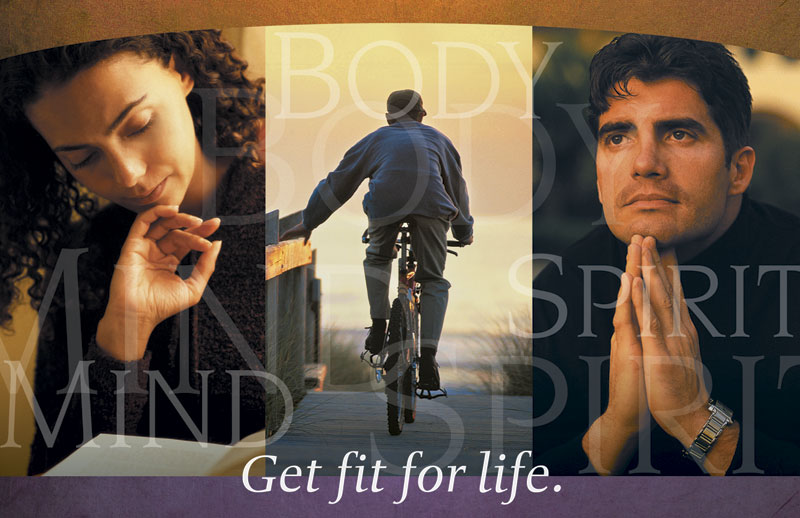
With the evolution of being equipped to follow Christ moving from education to formation, many people man now look upon church as a fitness club--getting in shape for Jesus. The difficulty with this idea is obvious--how many people are truly excited about getting regular exercise? Even more telling, how many are excited about getting regular spiritual exercise? Frankly, this is what trips most people up--we all can become spiritually lazy (and pastors are not exempt). We can often exist on a sort of spiritual inertia until some crisis intrudes for which we are spiritually ill-equipped, then it is a trip to the church-as-hospital. Also, like physical exercise, we don't really think of ourselves as having the time to spiritually exercise--we're too busy doing other things. So when we talk about getting "fit for life" or other fitness metaphor, people have to overcome inertia, busyness, and lack of motivation to show up on Sunday mornings--and we don't often make explicit what we're doing. What would you do if you simply showed up to your local fitness club and there were people working out on strange machines, and talking with each other (some in great shape, some "in progress") and no one gave you any sort of orientation? Or what if you showed up to a fitness club and the room was empty of equipment? You would likely head back out the door. That is what I suspect church often looks like to the unchurched--a lot of strange looking hardware (what is a chalice? a paten? candles? prayer books? hymnals? organ music?) and odd routines without any sort of guidance about how to use them or what they are for. We need to be more explicit about how we are forming and spiritually exercising people.

Finally, appropriate for the season, some people see the church as an inn, or hotel. On the bad side of this, the church can degenerate into being seen as a social club--an exclusive place where the "beautiful people" congregate to reinforce how nice things are. That was the genesis of the Dear Abby quote about the church not being a "museum for saints." We don't want to be seen as, or actually be, a place where one must be perfect to attend. I've seen people apologize for crying in church! Why apologize? Because it is seen as not "seemly." Well, church should be the one place in which we can express our deepest emotions, so cry away! People also can see the church as a place for rich people--much like going to a hotel with a fancy lobby. The question "Do I fit in here?" is often at the top of people's minds when the visit a church. I actually think that an inn is a wonderful metaphor for the church. We need to constantly look at how hospitable we are: Are we easily seen from the road? Is our signage good and clear? Can people find their way to our front door easily? Are they welcomed warmly when they do? Does the place feel like an exclusive club or a warmly welcoming bed and breakfast? We might even be seen as having a (spiritual) exercise room, a buffet (coffee hour?), a spa for healing (holy oil at the healing service?), even a classroom or two.

I'm going to continue to reflect on the inn metaphor for church in the coming weeks. I think it is a rich one. We often talk about the church as "my church" as if we somehow own it. This does make us feel more at home (after all, how much more at home can you feel then when you are at home?) but may make others feel like they are temporary and unexpected guests rather than potential members of God's family. I much prefer the image of the church building that I learned as a child: God's house. We are all in God's house. We are all staff (paid or unpaid) and we are welcoming guests who intentionally seek us out as a place to rest that is apart from the hustle and bustle of the world. We also need to be mindful that God is both our host and our permanent guest--we need to make sure we have room in each of our "inns" for God as the Christ child. We also need to be aware of whether we're "living the Gospel in a relevant way" as a church--making sure that we are adapting well to changing needs and providing things for which people seek out the church. I'm not suggesting that we become some sort of plastic "dream church" for everyone, but that we make sure that we are engaged in actively living the gospel in the world rather than merely supporting one another.

As we end Advent and approach the Christmas season, may we have room in our hearts for Christ, our homes for one another, and our church for those who seek a place of rest and refreshment--and perhaps an appointment with the One who is Emmanuel, God with us.

Friday, April 6, 2012

Where in the world is Jesus Christ?

Two Sundays ago I preached on "faith-full, fear-less" servanthood, with the key scriptural passage being:

If anyone serves Me, he must follow Me; and where I am, there My servant will be also; if anyone serves Me, the Father will honor him. - John 12:26, NASB
As I look out over both our congregation seated in the pews on Sunday morning and on the world at large, this statement of Jesus echoes in my mind: "where I am, there my servant will be also." When I was younger, there was both a PBS television series and a series of computer games with the title "Where in the World is Carmen Sandiego?" The series still exists today. The idea was to "track" Carmen Sandiego across the world, finding out about the various places she visited and attempting to catch her. As they current site history notes, the games were designed to stimulate interest in "geography, world cultures, astronomy and history."


It occurred to me as I was preparing, preaching, and reflecting on the sermon that if it is indeed true that as servants of Christ we are called to be where Jesus is, the question becomes: "Where in the world is Jesus?" While devoutly praying that there will not be a television series nor computer games with this theme, that question is one that need to continually ask as Christians.


Garden of Gethsemane
On Maundy Thursday, Jesus is with his disciples in the upper room eating the (early) Passover Meal, then later in the Garden of Gethsemane, where he is arrested and led through a long night of questions and confrontations. Today, on Good Friday, he is brought before Pontius Pilate and, at the urging of the crowd, condemned to death on a cross. We believe that somehow that death on the cross completed and solidified the bond between the human and the divine that allows us to call the creator of the universe "Abba" which means "Father" or, more specifically "Daddy" (yes, it is that informal).


On Sunday, we will celebrate our belief that Jesus Christ rose from the dead on the third day and appeared to the female disciples and then to the Twelve (actually, at that point, eleven--Judus was gone). He then appears to various others in various other situations, before ascending into heaven. Here is the problem: too often we metaphorically linger at the tomb, wondering what to do next, where Jesus has gone. We don't expect Jesus to appear in the world, perhaps even unexpectedly in our everyday lives. We often refrain from, to use a book title, Unbinding the Gospel. Even as Jesus' followers, we don't seem to fully grasp the fact that Jesus has been turned loose in the world--both through our hands and feet and through the Holy Spirit at work. As we again follow Jesus through death, burial, and resurrection, may we not forget that Jesus is loose in the world--and be on the lookout for him!

Monday, June 20, 2011

Institution and Transformation

It has been interesting to watch a sense of urgency surface amongst congregations around the 'need for new members'. This is precisely the problem. The focus should be on the power to change lives, the desire of persons to find our congregations to be incubators for the development of the faith and vehicles for sending Christians out into the world to witness in word and deed to the glory, grace of love of God.
- , "Everything is Transitory" in the blog The Missionary Leader
It has been an interesting couple of weeks at St. Edward's. A little more than a week ago, our Vestry gathered together for a Strategic Planning Retreat and began to talk about the long-term plans and future of St. Edward's--with a key difference. We didn't break out reams of paper and start brainstorming about things we wish we had or could do. Instead, we talked about the results of a demographic survey of the local area and how that might impact our future. Long about lunchtime, things were at a sort of a low point--this remains a challenging mission field. Yet as we transitioned from defining where we are now to looking at the possibilities for where we might be in the future, a fresh breeze of the Spirit began to waft through our little "upper room." We began to look towards future possibilities, not present or potential difficulties.

At the same time, these last two Sundays have invited us to look at the beginnings of the church--the giving of the Holy Spirit to both the disciples in the upper room and to the crowds on Pentecost Sunday and then the Great Commission (or, as my colleague Lauren Stanley preached: Go. Baptize. Teach. Need I say more?) yesterday (Trinity Sunday). As I mentioned in the announcements yesterday, this is priming the pump for a "summer of discernment" at both the parish and diocesan levels.  At the diocesan level, we're working our way through a strategic plan that will hopefully be adopted by Diocesan Convention in November and will be implemented in the months and years to come. On a parish level, we're more than halfway through my own three-year tenure as Priest-in-Charge and it is a good time to look towards our long-term future.

Yet as we do all of that, the desire and need to sustain the institution of the church can block out What is really important--our relationship with God in Christ through the power of the Holy Spirit. To the extent that we as a congregation and as a diocese function as incubators of faith, places where spiritually hungry people can not only get fed but can help fed themselves and others, we will be doing what God has called us to do and we will grow. To the extent that we focus on drawing people in so that we can sustain the institutional church we will devolve into just one more nonprofit organization with its hand out, looking for a piece of the increasingly smaller charity pie.

So, this will be a summer for discernment--for talking and listening. We'll talk about St. Edward's, about the changing demographics of the community around us, and about the evolving plan to engage that community with the transformational Gospel of Jesus Christ. As we do that, my prayer is that we will remember that it is our call to prepare a place where people may experience God's transforming power.

Monday, March 7, 2011

Lent and "Enough"

As we count the days until Lent (finally!) begins, some of the "self-examination and repentance" might well focus on what we have and how much we need--how much is enough. A recent article entitled "When Rich People Do Stupid Things" makes the point that wealth can be just as addictive as anything else--some people never have enough. On the other hand, one only needs to go as far as St. Paul, who writes:
"I know what it is to be in need, and I know what it is to have plenty. I have learned the secret of being content in any and every situation, whether well fed or hungry, whether living in plenty or in want." (Philippians 4:12).
Most folks are not the ĂĽber-rich described in the article. Yet how much of our time, energy, even prayers are consumed with consumables? How much of our lives are focused on our next paycheck, our next payout, or our next payback? Time for some self-examination and repentance, perhaps?

The author of the article ends it with the assertion that researchers are in agreement on the following:
"Money isn't the key to happiness. What really gives people meaning and happiness is a combination of four things: Control over what they're doing, progress in what they're pursuing, being connected with others, and being part of something they enjoy that's bigger than themselves."
I think pursuit of wealth is a symptom, not the disease. The problem is that we have (again, literally) been sold a lie--that wealth equals power and control. Who doesn't feel out of control these days? When people feel out of control, they look around for something the can control and that (they believe) can help them control their lives, and wealth is at the top of the list.

It's a lie.

Of course, wealthy people do have more choices than poor people do. The wealthy have more "discretionary income" and so their choices are expended beyond simply needing to put food on the table and keep a roof over their heads. But wealthy people ultimately have precisely as much control as anyone else--and that is not much. We don't know whether an earthquake will take place tomorrow and wipe out our homes, businesses, even churches (witness the quake in Christchurch, New Zealand). Even individually, we don't know what is going to happen in our lives.

What faith can do, and what church can strengthen, are the last two items in the list: being connected with others, and being part of something they enjoy that's bigger than ourselves. As we enter Lent, perhaps the best self-examination and repentance we could engage in is identifying how much time, effort, money, and even prayer goes in to maintaining that illusion of control and diverting that into strengthening one's own faith in God and support for the church. Who knows? God may do something new...

Saturday, January 8, 2011

Light and Life: Epiphany

Hail! the heaven-born Prince of Peace!
Hail! the Son of Righteousness!
Light and life to all He brings,
risen with healing in His wings.

Hark! The Herald Angels Sing
-- Charles Wesley(1707-1788), 1739
A little light-hearted (pun intended) offering for today:


Several days ago, we marked the end of the Christmas season on Epiphany (January 6), the celebration of the arrival of the Magi at the stable in Bethlehem. Never mind that the chronology is problematic (i.e. how did they get there in 12 days, and why were Joseph and Mary in the same spot 12 days later, but I digress...). The point (I think...) is that Jesus was worshipped by Jew and Gentile alike from the moment of his birth--there was a recognition that God was doing something new and momentous in the world.

I always choke a bit on Christmas carols, such as Away in a Manger, that like to romanticize the birth narrative of Jesus. There is a sense from these songs that Mary and Joseph wandered into the sleepy little town of Bethlehem after a quick trip down the interstate, dropped by a local Motel 6, saw a "No Vacancy" sign, and settled into a nice comfortable stable where Jesus was born in serene silence with some nice heavenly music playing in the background. To the extent that the story is accurate, what you really have is a young couple forced by the authorities (occupying forces, no less) to make a perilous journey through often dangerous places to a town that had probably quadrupled in population, likely spending at least hours if not days trying to find somewhere, anywhere safe, to have a child that was literally in the process of being born and finally ending up in a cave or shabby outbuilding amongst none-too-clean animals and finding only a feeding trough to lay the newborn Jesus in as Roman soldiers patrolled the streets outside on alert for trouble. I'm guessing that Jesus probably was like most other children and screamed his lungs out at his birth. So, the story is pretty much of a young couple in trying circumstances having a baby in a filthy stable after being exhausted by travel and a fruitless search to find adequate lodging. Hardly the scene for the most important birth in human history!

Oddly enough, the story of the Prince of Peace being born in less-than-ideal circumstances, into a highly unsafe territory occupied by Roman forces gives me plenty of comfort. As I mentioned in my sermon last Sunday, Jesus is not born into peace, Jesus is our peace. God did not wait for ideal circumstances to break into the world in the person of Jesus--the flight into Egypt to avoid Herod's massacre of the children of Bethlehem demonstrates that. What God does do is come into our messy, harried, less-than-ideal lives and transforms them from the inside out. Slowly, even imperceptibly, but constantly and surely.

That's really what this Epiphany season is all about: light in darkness. The liturgical season of Epiphany highlights that in the midst of the winter darkness and cold, the light of Christ breaks in, warming and illuminating our lives. How will we each carry that light into the world?

Wednesday, December 8, 2010

Jars of Clay or Feet of Clay?

But we have this treasure in jars of clay to show that this all-surpassing power is from God and not from us. - 2 Corinthians 4:7

Last week I was thinking about the Gospel passage for this past Sunday, the Second Sunday of Advent, I thought about the Gospel as meaning "good news" and how much bad news surrounds us, even bombards us, on a daily basis. The economy is a shambles, people continue to struggle to make ends meet--even governments are struggling to make ends meet--and there seems to be a daily litany of people who we have put our hopes in to get us out of this mess and inevitably disappoint us with either personal failings or failing to move in the direction we think they should. They truly have "feet of clay," easily shattered.

By contrast, John the Baptist is not the least bit setting himself up as the solution to any problem. In fact, he is probably the least likely person you would want as a problem solver. He has this distressing habit of speaking his mind, no matter what that is, and he's not one for subtlety. As I thought about him and his message, I recalled the above passage and several things seemed to click. The fact is, all of us are clay jars--unadorned, perhaps dirty, hardly worthy of a second look from outside. And yet we have a treasure within us: the power of God to transform us and those around us. That's what the Incarnation is all about--God with us. May we know ourselves to be bearers of the light of Christ just as Mary was the bearer of the Christ that first Christmas.

Sunday, October 31, 2010

Setting Us Free

"The inherited churchly institutions in the United States are typically engaged in inducing people to join, support and attend church ... in order to worship the church, not to glorify and enjoy God, and in order to enhance some churchly cult, not to esteem and enact the Gospel.  The sanction for this appeal is a venerable one - the sale of indulgences.  (People) are persuaded that by serving the church, by spending time and money and talent on the church, they can accomplish and exchange for merit and gain a justified status with God.  Yet secreted in the idolatry of church is the same futile worship of the power of death inherent in any idolatrous relationship. And from that, even when it is shrouded in the trappings of church, has Christ set (us) free." -- William Stringfellow, Imposters of God
A colleague of mine recently wrote a very interesting blog post referencing the above book. As someone who is Priest-in-Charge of a church in what I have often referred to as "the rebuilding phase" of its life, the above is pretty convicting--too often the church can become an end in and of itself rather than a means to the end of proclaiming the Gospel in word and deed. Though we have already set out our mission and vision at St. Edward's, the challenging part remains--discerning how God is calling us to live out, or incarnate, that mission and vision.  This morning I talked about the "the hope to which he has called [us]" (Eph 1:18b) to which St. Paul refers. That hope is the hope of All Hallows Eve and All Saints Day, that even death has been overcome to such an extent that we can make fun of it by dressing up as ghosts and goblins!

So where do we go with that hope? What do we do with it? How do we communicate it? And who will go with us? Stay tuned....

Thursday, October 21, 2010

Room for Transitions

When talking with one of my wisdom friends recently (wisdom friend means someone with more grey hair than me) they talked about how we often don’t make room in our lives for times of transition; we don’t consciously acknowledge and attend to the emotional space of life changes, be they hopeful changes such as a new job or new opportunity or tough changes such as the loss of someone or the physical or cognitive changes in ourselves or those we love. Too often, they said, we tend to expect the same of ourselves in these moments as we do in other periods of our life. Too often we don’t find ways to mark and face openly that which our guts are registering quite clearly. -- Todd Donatelli, Father of the Bride blog entry at Episcopal Cafe

Though discussing the upcoming marriage of his daughter, Dean Donatelli makes an excellent point about making "room in our lives for times of transition." However, when I think of transition I think about the last year of my own life and the life of this congregation. My family and I had the transition of moving to temporary housing in San Carlos a year ago and then moving again to the Rectory in September. While we are profoundly grateful for a wonderful house and it is wonderful to be able to simply walk across the parking lot to and from work, this has certainly been a year of multiple transitions for our family. Of course, St. Edward's has been in transition for more than 18 months since my predecessor and others departed. We've spent the almost the entirety of my time here attempting to live into our identity as "ransomed, healed, restored, [and] forgiven" people, and we're making progress in that effort. When I look back on the last year, I can hardly believe all of the changes that have occurred!

So, it is perhaps past time to give ourselves a little room to settle in to this transitional period. The first "room" will be our combined All Hallows Eve/All Saints Day service at 9 a.m. a week from this coming Sunday, on October 31. We will gather, we will celebrate, we will take a breath, and we will liturgically and literally break bread together at the Eucharist and potluck, respectively. The second opportunity for "room" will be a four-week series on "Being the Church in the 21st Century" that will be on Wednesday evenings during Advent (December 1, 8, 15, and 22) from 7:30 to 9 p.m. in Hallstead Hall. We'll look at the various cultural shifts occurring in the world and how we as a church might not only survive but position ourselves to thrive in such a culture. More information to follow, and other opportunities for "room" will be announced as they occur.

Monday, May 31, 2010

Three Critical Questions for St. Edward's

I'm in the midst of an online conversation over on Episcopal Café in response to a recent post. In that conversation, I ask the following questions:
  1. Do we believe in the transformational power of a relationship with Jesus Christ?
  2. Do we believe that the Episcopal expression of Christianity has real value for people in a post-Christian society?
  3. Are our churches prepared to actively welcome, receive, incorporate, and form new believers?
I'm also reflecting on the conversation we had yesterday after church regarding moving from our single 9 a.m. service on Sunday morning to an earlier and a later service. I believe that there was a real consensus that we did not simply want to replicate the "pre-split" schedule and, most especially, did not wish to go back to thinking of ourselves as "8 o'clockers" or "10 o'clockers" that were essentially two seperate churches using one building. One thing that this transitional period has done is to bring those who stayed at St. Edward's together, and while there seems to be agreement that we need to move forward in this way, there is equal agreement that no one wants to go back to the two-churches-in-one-building model.

As I articulated at that meeting, I'm also not interested in simply having the earlier service as merely some sort of holding area for those who prefer traditional liturgy and music, simply sustaining the service without putting more than the minimal resources and attention towards it.  Rather, I would prefer that we actively market and give attention to both services, making sure that we do them both well and that we actively invite and incorporate people into both. If we truly believe that the Episcopal expression of Christianity is worth people's time, money, and effort, then we need to act on that belief with energy, enthusiasm, and our own time, money, and effort. The exact form of that action will be discerned over the next couple of months, but the opportunity of (re-)forming a community of faith so that all three of the above questions may be answered with an unqualified YES is an exciting prospect not to be missed!

Monday, April 12, 2010

Alleluia, Christ is risen! Now what?

One of the interesting things about the lectionary (cycle of readings) in Eastertide is that we take a temporary break from the Old Testament in favor of readings from the Book of Acts, the earliest history of the church. Yesterday, we began with the testimony of the disciples to the authorities of the day--stating unequivocally "we must obey God rather than any human authority" in response to an order to not to teach in Jesus' name. The authorities note that the disciples have "filled Jerusalem with [their] teaching."

What a difference two-thousand years makes! Today, we have many voices claiming the moniker of Christianity, from a variety of social and political viewpoints. Yet, author Katherine Tyler Scott, in a recent book (Transforming Leadership) and an even more recent Washington Post article, says this about the Episcopal Church in this cacophany of voices:

At its core, the Episcopal Church believes in the compatibility of tradition and reform, the partnership of faith and reason. If the church can remember and reclaim this charism, it will help those who follow to navigate the present currents of complexity, chaos and change with reasoned and mature judgment and action. It will enable the church, and all of us, to exhibit the courage to move from the margin, to stand in the gap, to hold the tension of the opposites together, and to take the risk to tell our truths in the world--a world that desperately needs to shed itself of the tendency to demonize differences.

That is perhaps what I like most about my often-conflicted church: at our best we hold that tension between opposing views, forces, and paradigms.  The challenge facing us as a church is to present that tension-holding not as lack of decisiveness or a failure of nerve (assuming it is not), but as a gift to the church and to the world. Perhaps "training for tension" might be an apt description of the Episcopal Church's divine task: teaching people how to hold the center without being torn apart in the process.

Friday, February 19, 2010

40 Days of....?

After a brief interlude following Epiphany, the church calendar now plunges us into the 40 days of Lent (Sundays don't count--being festival days--so that's why it isn't 40 calendar days). Those 40 days are meant to call to mind the days of our Lord's temptation in the wilderness--and not a peaceful, shady wilderness like I'm used to in Oregon and Northern California, but a desert wilderness. A friend of mine passed the following along. See what you think...


I sometimes think that our world is in a sort of wilderness time. Certainly our church is! There seem to be many, many problems to overcome. Health care reform, poverty, greed, joblessness, etc... At the same time there seem to be so few people, especially in the political arena, with the courage to confront and even begin to address these problems. In the Episcopal Church, we continue to wrestle not only with the obvious issues of sexuality but with what I would consider the more important and more basic issues of meaning and purpose in the 21st century.

We are firmly now in a post-Christendom society, especially here in Silicon Valley. People need a compelling reason to be involved in a church and that involvement means not being involved in the myriad of other possible things available. How do we in the church recapture that core sense of transformational power that is the essence of the Gospel and then translate it into a compelling witness to the world? It is a question that other generations have had to grapple with, but we are at that 500 year point that Phyllis Tickle writes about in The Great Emergence in which everything is pretty much up for grabs. My contention is that it that uneasiness, that dis-ease, which is infecting the church and causing us to be less confident of the Gospel we proclaim, not any issue like sexuality. May this Lent serve to remind our own congregation and the wider church of the power of the Gospel message amidst the temptations of the world.

Monday, December 7, 2009

Hurry up! No, wait....

As I write this blog entry from my office with the patches of sunlight streaming through my window, I am thinking about the fact that Christmas is less than three weeks away. On Thursday, it will be exactly two weeks away. I have now been here for a little over eight weeks--two months--and there are still boxes to move or unpack (in both office and home) and what seem like a million things to get done. Into that sense of urgency, Christmas can sometimes seem almost like an intrusion. One is almost tempted to say to God: "How dare you interrupt my important work, everything I need to get done, with yet more things that need to get done because of Christmas?!"

And yet, as the video below illustrates, Christmas is not intended to be an additional burden to add to the stack, but as an opportunity for transformation. Advent, then, is the opportunity to prepare for such transformation:


This video challenges me as a father, a person, and perhaps especially as a priest, to look at my own life and ask where God is trying to break in, to transform me into the person he wants me to be. That transformation will not occur because I crossed the last thing off my to-do list, as if that ever happens, but can only occur if I make the time to put aside the list for the one thing that actually makes a difference--the coming of Jesus. As these next few weeks roll by, join me in stepping back, taking a breath, and preparing, really preparing, for transformation. Who knows what God might do?

(thanks to Irenic Thoughts, the blog of King of Peace, Kingsland, GA)